Septic in Hernando, without the guesswork
Straight answers on how Mississippi actually permits a system, why the water meter is what sets the whole process going, and what DeSoto County loess does once it gets wet.
- 41-67-3The governing statute
- 5 ftBoring depth
- 100 ftField to any well
- 24 inMin. to water table
- Sourced from published rules
- We do not sell septic work
- We refer only to licensed pros
- Never a charge from us
Silt that stands up dry and slumps wet
Almost every argument about a septic system is really an argument about soil. Get that part right and the rest of it is paperwork.
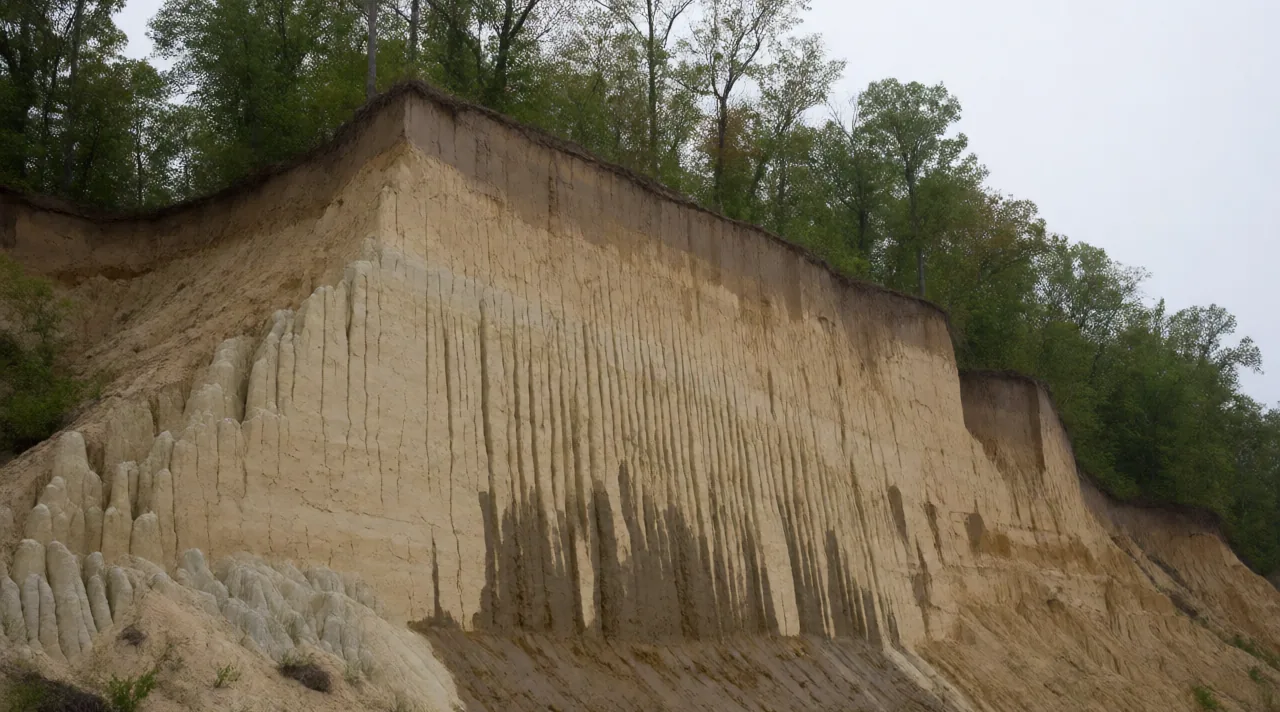
DeSoto County sits on the loess bluff: a blanket of wind-blown silt, tens of feet thick in places, laid down over the sands of the Memphis aquifer. Loess is unusual ground. It holds a vertical face when it is dry, which is why the road cuts here stand up like walls, and it loses that structure almost entirely when it is saturated. Underneath the silt, many DeSoto profiles carry a fragipan: a dense, brittle layer water will not move through. The silt is not the problem. The depth to that pan, and how high water stacks on top of it in a wet winter, is the whole design.
A conventional system is three jobs in a row, and only the first two are equipment. The tank separates, the distribution box shares the flow out, and then the soil itself does the treating. When people say a septic system failed, what they nearly always mean is that the third part stopped working, because the ground was never able to do the job it was being asked to do.
The test that decides everything
A licensed evaluator is not guessing and is not consulting a map. They put holes in your ground and watch what water does. Two lots on the same street can come back with completely different answers, which is exactly why nobody can quote you honestly over the phone.
What that leaves you with
The question on a DeSoto lot is almost never whether the topsoil drains. It is how much unsaturated silt sits above the fragipan, and whether that margin survives February. The evaluator reads it off the colour: grey mottling at chroma 2 or less across at least two percent of the soil volume is the mark a seasonal water table leaves behind, and it stays legible long after the water has gone. Where that mark is shallow a conventional trench has nowhere to sit, and the design moves up into a mound or across to an advanced treatment system.
Not us, not a contractor on the phone, not a soil survey. The design follows the boring log. That is why the evaluation is the first thing you pay for, and why a quote given before one is worth precisely nothing. Get local pros to quote the evaluation →
What it costs
Ranges, not a price list. Mississippi does not publish installed costs and neither do we. Where a job lands inside these bars is decided almost entirely by what the boring finds, because that is what dictates whether you are buying a trench, a mound, or a treatment plant.
Where to start
What On-Site Wastewater Really Costs in DeSoto County
Realistic 2026 cost ranges for DeSoto County, and why the soil boring rather than the house is what decides whether you are buying a trench.
The Water Meter Rule: Why Septic Comes Before Water
In Mississippi the Permit/Recommendation is what gets you a water meter, and Rule 1.2.2 counts a change of ownership as a connection event.
How a Mississippi On-Site Permit Actually Works
The MSDH permit path under Title 15 Part 3 Subpart 77: the Notice of Intent before you build, the soil and site evaluation.
Septic Repair in Hernando, Southaven, Olive Branch
Wet spots, backups or smell in DeSoto County? How systems on loess and fragipan fail, what repair usually involves, and when MSDH has to be part of it.
Areas we cover
Hernando
The county seat. Sewered in the centre, on-site once you are out on the acreage.
Southaven
Largely sewered, but the southern and eastern edges run out of service line quickly.
Olive Branch
Fast growth on large lots. A great deal of new on-site work happens here.
Horn Lake
Mostly sewered. Older outlying properties are the exception.
Walls
Low ground near the river, where water table depth does the deciding.
Nesbit
Unincorporated acreage between Hernando and Southaven. Effectively all on-site.
Common questions
Do I need a permit to install or replace a system?
Yes, and it is not a formality. the Mississippi State Department of Health is the permitting authority statewide through its Division of On-Site Wastewater, so there is no county office writing its own rules here. Work that goes in without one is work that has to come back out, and it will show up again the day you try to sell.
How much does a new system cost here?
For most local lots the honest answer is a range, not a number. The bars on our cost page show what each system type typically runs installed. Where your job lands inside them is decided by the soil boring, not by the house.
How long does the whole process take?
Weeks, not days. The evaluation, the design, the review and the inspection each wait on somebody else's calendar. Homeowners who start early are the ones who avoid delaying a build or a closing.
Can you tell me what my lot needs?
No, and neither can anyone else who has not dug a hole on it. Soil maps are a starting point and nothing more. The design follows the boring log, which is why the evaluation is the first thing you pay for rather than the last.
Request a septic quote
We read every request and pass it to a licensed local professional covering DeSoto County where one is available. We are still building our list of professionals here, so we cannot promise one is available or say how quickly they will respond.